
Glass Railings in Abu Dhabi
Frameless, base-channel and standoff glass balustrades for balconies, staircases, terraces and mezzanines. A railing is a structural barrier before it is a design feature. It has to hold someone who falls against it — and keep holding them after the glass has broken.
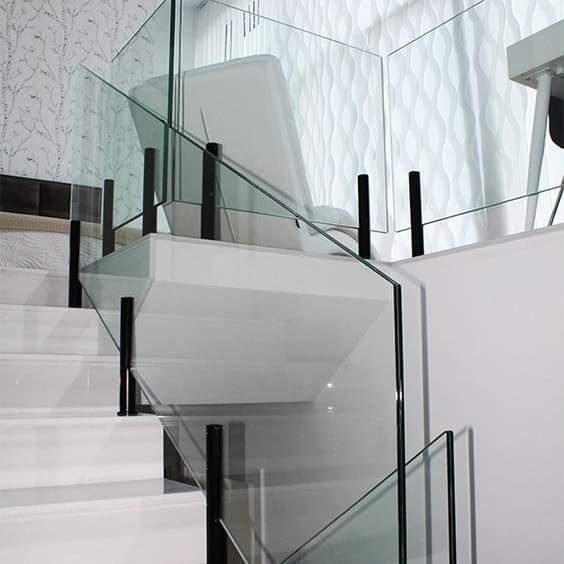
A Balustrade Is a Barrier, Not a Screen
Every other glass product on this site gets judged on how it looks and how it seals. A balustrade gets judged on whether it stops a person going over the edge. That one difference drives every decision that follows.
Barrier glass has to resist a horizontal load along its top edge — the load a person makes leaning, stumbling or being pushed into it. How much load depends on where it is: a private balcony and a crowded public terrace are different design cases, and the figure comes from your project’s structural design, not from a brochure.
The second requirement is what happens after breakage. A barrier that vanishes when the glass breaks is not a barrier. That is why laminated glass is the standard answer — the interlayer holds the broken panes together so the panel keeps standing in the opening.
Toughened, Heat Soaked, Laminated
Toughened
Heat-treated to be several times stronger than ordinary glass, and it breaks into blunt granules. That is the starting point for barrier glass — but toughening on its own leaves two problems open.
Heat soak tested
Toughened glass can break spontaneously years later because of microscopic nickel sulphide inclusions trapped inside it, which expand very slowly. Heat soak testing holds the finished panels at an elevated temperature for hours so contaminated panels fail in the oven instead of on your balcony. It removes the great majority of that risk.
Laminated
Two toughened panes bonded to a structural interlayer. When one or both break, the fragments stay stuck to the interlayer and the panel keeps working as a barrier. Over a drop, that is not an upgrade — it is the entire point.
Interlayer type
PVB is the common one. Stiffer structural interlayers such as SGP hold a broken panel more rigidly, which matters on a frameless panel relying on the glass itself rather than on a handrail.
| Toughened only | Toughened + heat soaked | Laminated | |
|---|---|---|---|
| Strength | Several times stronger than annealed | Same | Same, in two bonded panes |
| If it breaks | Panel falls out — the barrier is gone | Same | Fragments stay on the interlayer; panel keeps standing |
| Spontaneous breakage risk | Present (nickel sulphide inclusions) | Largely removed | Largely removed when heat soaked too |
| Suitable over a drop | No | Not on its own | Yes — this is the specification that makes sense |
Base Channel, Standoffs or Posts?
A continuous aluminium U-channel bolted to the slab, with the glass set and wedged into it. The cleanest frameless look. It puts the whole load into the slab, so the fixing substrate and the slab edge have to be right.
Stainless discs holding the panel off the face of the slab or the stringer. Visually light, and useful where you cannot recess a channel. Load concentrates at each fixing rather than spreading along the base.
Aluminium or stainless posts with glass infill between them. The posts carry the load, so the glass is doing less structural work. Usually the cheapest option and the most forgiving of an imperfect substrate.
A capping handrail ties the panels together and shares load between them. Take it away and it looks better but asks more of every single panel — which normally means thicker glass or a stiffer interlayer.
Three Failures Worth Avoiding
Fixing into the wrong thing. A base channel is only as strong as what it is bolted to. A slab edge that is cracked, thin or poorly compacted will not hold under load, and no amount of good glass makes up for it. The fixing detail has to be sorted before the glass is ordered, not after.
Corrosion at the fittings. The glass does not corrode. The stainless fittings, bolts and anchors do, especially in coastal air. Grade matters, and so does keeping dissimilar metals apart. If your project is on the water, tell us — it changes what should be specified.
Monolithic toughened glass over a drop. It looks identical to a laminated panel and costs less. It is also the spec that leaves an open edge when a panel breaks. See more of our glass work and aluminium fabrication.
Glass Railings Across Abu Dhabi
We fabricate and install glass balustrades for villas, towers and commercial buildings. We work right across the emirate — Khalifa City, Mohammed Bin Zayed City, Al Reef, Al Reem Island, Saadiyat Island and Yas Island.
Send us the run length, the drop height and a photo of the slab edge or staircase. The fixing condition decides the system before the glass does.→01Does a glass balustrade have to be laminated?
For any barrier protecting a drop, laminated is the specification that makes sense — the interlayer holds the broken panes together so the panel keeps working. Monolithic toughened looks identical and costs less, but leaves an open edge if a panel breaks. The exact requirement for your project comes from its structural design.
02What is heat soak testing and why should I care?
Toughened glass can occasionally break on its own years after installation, because of microscopic nickel sulphide inclusions inside the glass that expand over time. Heat soak testing holds the finished panels at an elevated temperature for several hours so contaminated panels break in the oven rather than in service. It takes out most of that risk, and it is worth specifying on any balustrade.
03Do I need a handrail on top?
Not always, but it changes the engineering. A capping handrail ties the panels together and shares load between them. Remove it and every panel carries its own load alone, which normally means thicker glass or a stiffer structural interlayer. Frameless without a handrail is very achievable — it just is not free.
04Which fixing system should I use?
That depends far more on what you are fixing into than on taste. A base channel gives the cleanest frameless result but needs a sound, properly detailed slab edge. Standoffs suit a slab face. A post system asks the least of the substrate and costs the least. We look at your edge condition first, then talk about the look.
05Will the fittings corrode near the sea?
Stainless steel is corrosion resistant, not corrosion proof, and coastal air is aggressive. The grade, the detailing and keeping dissimilar metals apart all matter. If your project is on or near the water, say so at quote stage so it gets specified for that rather than generically.
06Can you match an existing balustrade?
Usually. Send close-up photos of the fixings and the top edge plus a measurement of the glass thickness, and we will tell you what will match exactly and what will only be an approximation.